

Calculating ROI on Bore Repair Equipment: A Practical 2026 Guide

What if the right answer isn’t a generic payback period, but a calculation built from the repairs your operation actually handles? Calculating ROI on bore repair equipment is difficult when repair invoices, downtime, and internal labor aren’t measured on the same basis. Next year’s repair volume may also look very different from this year’s.
A bore welder or line boring machine makes financial sense when the expected work, utilization, ownership costs, and training needs support the investment. A broad industry estimate can’t replace your operating data.
This guide shows you how to build a project-specific ROI model using repair history, outside repair costs, downtime, labor, expected annual repair volume, equipment utilization, and training. You’ll account for full ownership costs, test how changing repair frequency affects payback, and make your assumptions easy to adjust. The result is a transparent business case decision-makers can review without relying on a one-size-fits-all claim.
Table of Contents
Why Calculating ROI on Bore Repair Equipment Requires Your Own Operating Data
Build a Bore Repair Equipment ROI Calculation from Clear Inputs
Compare In-House Bore Repair Scenarios Without Assuming One Payback Threshold
Stress-Test Your Bore Repair Equipment ROI Before Presenting the Business Case
Turn the ROI Analysis into a Practical Bore Repair Equipment Decision
Why Calculating ROI on Bore Repair Equipment Requires Your Own Operating Data
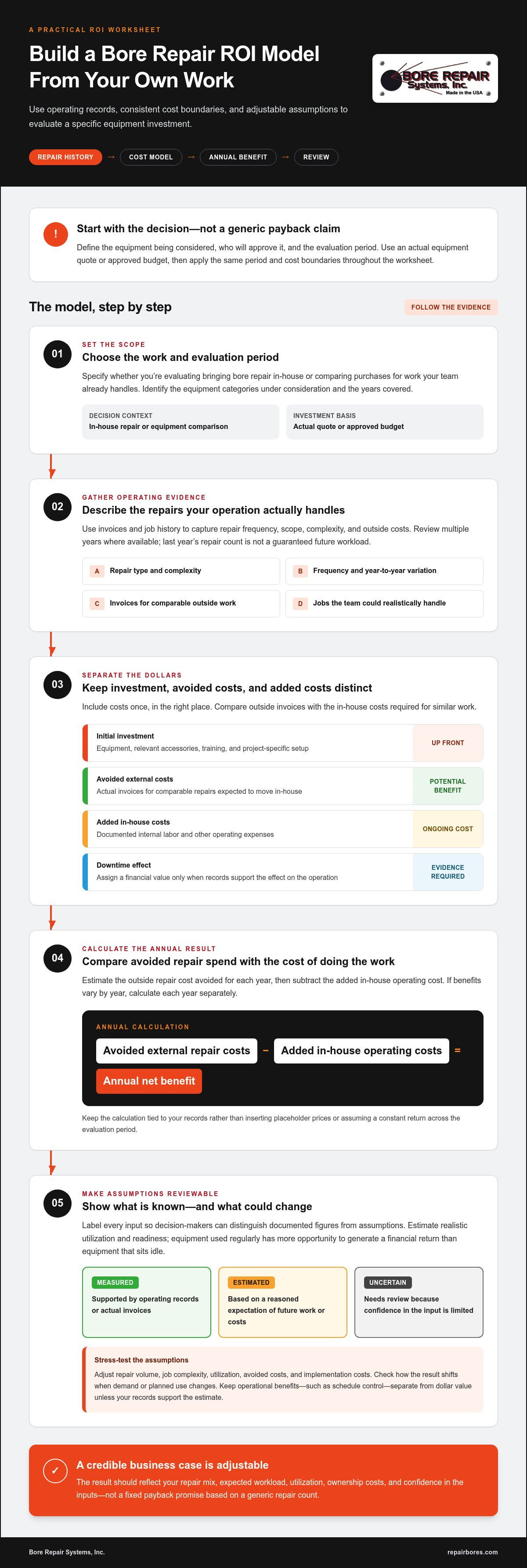
A return estimate is useful only when it reflects the work your operation expects to perform. Calculating ROI on bore repair equipment means comparing the financial return from a defined operating case with the investment required to support it, over a set evaluation period. It won’t tell every business whether equipment ownership is worthwhile. It will show whether a specific setup makes financial sense for your expected repair mix, workload, and costs.
Which bore repair decision is the calculation meant to answer?
Start by defining the decision. Are you evaluating the cost of bringing bore repair in-house, or comparing equipment purchases for work your team already handles? Identify who will approve the investment, which equipment categories are under consideration, and how many years the analysis covers. A concise definition for your business case is: ROI for bore repair equipment is the financial return from a specific equipment investment, measured against that investment over a defined period.
For a basic explanation of the concept and its limitations, see these Return on Investment (ROI) principles. Keep the financial calculation separate from operational benefits. More control over repair scheduling may matter to your operation, but don’t assign it a dollar value unless your records support the estimate.
Why generic payback examples can mislead
Repair counts alone don’t show whether two operations have comparable economics. A straightforward bore repair and a complex job may require different labor, time, and equipment. Training and ongoing operating costs also affect the result. Published examples can help frame questions, but they aren’t a forecast for your operation.
Build the case from records that describe your actual work. Gather repair invoices and job history, then sort the work by type and complexity. Record what you paid for outside repairs, how often each type of work arose, and which costs an in-house process would add. Next, estimate realistic equipment utilization. Equipment that sits idle for much of the evaluation period has less opportunity to generate a financial return than equipment used regularly. Don’t treat last year’s repair count as a guaranteed annual workload. Review multiple years of records where available, and account for known changes in demand.
Before comparing options, make the assumptions visible to decision-makers:
Repair history: Record frequency, scope, and variation from year to year.
Outside costs: Use actual invoices and distinguish the types of work included.
Planned use: Estimate which jobs your team could handle and how often.
Readiness: Include training and operating needs in the case, not as afterthoughts.
This makes the estimate easier to challenge and adjust. If repair volume falls, job complexity changes, or utilization is lower than planned, the model should show how the result shifts. That is more credible than promising a fixed payback after a set number of repairs.
Build a Bore Repair Equipment ROI Calculation from Clear Inputs
Use a worksheet another manager can follow and adjust. Start with one evaluation period, such as the period your organization uses for capital decisions. Apply it consistently to costs and benefits. Record the equipment investment from an actual quote or approved budget, not an industry average. Mark each input as measured, estimated, or uncertain so reviewers can see which figures come from records and which rely on assumptions.
Which costs and benefits belong in the worksheet?
Separate the upfront investment from costs that continue during operation. Include the equipment, relevant accessories, training, and project-specific setup costs in the initial investment. For ongoing costs, use documented internal labor and operating expenses where available. Compare these costs with actual outside repair invoices for similar work. Avoid counting the same cost twice, such as including training in both the initial investment and annual operating costs.
Build the worksheet with clear labels:
Initial investment: Equipment quote or approved budget, accessories, training, and setup.
Avoided external costs: Invoices for comparable repairs the team expects to handle in-house.
Added in-house costs: Labor and other operating costs required to complete that work.
Downtime effect: Include a financial value only when records support how downtime affects the operation.
Schedule control may be operationally valuable, but don’t convert it into a dollar benefit without a defensible method. Broader ownership-cost context is also discussed in Cost of Line Boring Machine: 2026 Pricing Guide and ROI Analysis. Use the same cost boundaries in that discussion and in your own model.
How to calculate annual benefit and payback
For each year, estimate the external repair cost avoided, then subtract the added cost of doing that work in-house. The result is the annual net benefit. Use variables rather than placeholder prices so the formula stays tied to your records. If benefits vary by year, calculate each year separately instead of assuming a constant return throughout the evaluation period.
Annual net benefit = avoided external repair costs − added in-house operating costs
When annual net benefit is positive, estimate simple payback as:
Simple payback period = initial investment ÷ annual net benefit
This is a rough time-to-recovery measure, not total ROI. For the chosen period, add the annual net benefits, subtract the initial investment, then divide by the initial investment and multiply by 100 to express ROI as a percentage. State which costs are included, whether financing or tax effects are excluded, and how uncertain inputs were handled. If annual net benefit is zero or negative, simple payback doesn’t produce a meaningful recovery period.
A clear model is easier to review when its assumptions are visible. To discuss which equipment categories fit your project, contact Bore Repair Systems, Inc. - Bore Repair Made Easy with our USA made Lineboring and Boreweld solutions about your ROI inputs.
Compare In-House Bore Repair Scenarios Without Assuming One Payback Threshold
A single forecast can hide how much repair volume drives the result. Compare the current outsourced approach with at least two in-house cases: one based on lower, dependable demand and another based on higher utilization your operation could realistically support. Use the same evaluation period, repair scope, equipment investment basis, and cost categories in each case. Change only the assumptions you’re testing.
What changes when repair volume rises or falls?
Separate scheduled work from occasional repairs. Scheduled demand gives you a firmer basis for estimating equipment use. Treat uncertain or one-off work as a separate assumption, not guaranteed volume. As repair frequency rises, more avoided external costs may contribute toward the fixed investment. If jobs are less frequent, that contribution falls, even if the equipment and other fixed costs stay the same. There is no universal repair count that makes a purchase worthwhile.
Use a comparison like this, then replace the descriptions with your annual job estimates and model outputs:
Don’t count occasional jobs as dependable just to improve the estimate. If the higher-volume case relies on work that isn’t booked or established in your repair history, label that assumption clearly. Calculating ROI on bore repair equipment is more useful when decision-makers can see which scenario depends on confirmed demand and which depends on growth.
How should downtime and outsourcing be compared?
Start with documented outside invoices for comparable repair scope. Add a downtime benefit only when records show a measurable financial consequence, such as a documented production loss tied to repair delays. Check that the same impact isn’t already included elsewhere in your model. Keep scheduling flexibility, transport coordination, and logistical effort visible as operational considerations when you can’t reliably assign them a monetary value.
Results also depend on whether trained staff can complete the expected work, how much time they can dedicate to it, and what each repair requires. Compare those conditions across scenarios instead of assuming utilization will automatically reach the higher case. For a broader make-or-outsource discussion, see In-House Line Boring vs. Outsourcing: Heavy Equipment Repair Guide 2026.
Stress-Test Your Bore Repair Equipment ROI Before Presenting the Business Case
A forecast is only as strong as its assumptions. Before presenting the business case, build conservative, expected, and higher-utilization scenarios. Keep the evaluation period and cost definitions consistent, then change specific inputs to show how sensitive the result is. Decision-makers can then see a range of possible outcomes instead of treating one estimate as certain.
Which assumptions should decision-makers challenge?
Start with the repair mix. Do the forecast jobs match the work the selected equipment category is intended to support? Check that planned repairs fit the expected scope, and separate known demand from work that is only possible. Review internal labor, accessories, training, and ongoing operating costs for omissions. For every avoided outside cost, keep a supporting invoice, work order, or other record.
Give each input a confidence label. A value based on complete invoices may be high confidence; an estimate based on incomplete job records may be medium or low confidence. Don’t disguise a gap as a precise number. List the missing evidence and show how the result changes if an estimate proves too optimistic.
How should uncertainty and implementation be shown?
Use a sensitivity table to isolate the inputs with the greatest effect on the result. Change one input at a time while holding the others steady, then test a combined conservative case. Include training and implementation in the model as project costs or operating inputs, using your own estimates and clearly marking what remains uncertain. For more on training as an investment input, see Investing in Training: ROI for Heavy Equipment Repair Teams.
Keep operational benefits, such as more control over scheduling, visible in a separate section unless you can substantiate their financial value. That preserves their importance without overstating calculated ROI. To review the assumptions behind your bore repair equipment case, discuss your project inputs with RepairBores.
Turn the ROI Analysis into a Practical Bore Repair Equipment Decision
A useful ROI model should lead to a clear decision, not just a percentage. Summarize expected repair demand, annual net benefit, simple payback, scenario range, and confidence in the supporting inputs. State what would change the recommendation, such as lower utilization or added implementation costs. This gives decision-makers a practical view of both the potential return and the assumptions behind it.
Match the proposed investment to the bore repair work being evaluated. A bore welder, line boring machine, bore sizer, or accessory may play a different role in the project, so keep the analysis tied to the relevant equipment category and repair scope. Include line boring and bore welding training in planning where it applies. Treat training as an input to the investment, not a promise of a particular financial result.
What information should you prepare for an equipment discussion?
Bring the records that help explain your specific case. Organize the information before discussing options, and flag gaps rather than filling them with guesses.
Repair history, outside invoices, work orders, and estimated annual job volume.
Current process costs, including documented labor and operating inputs.
The bore repair work and equipment categories under consideration.
Your evaluation period, scenario results, and the assumptions that most affect ROI.
Missing records or estimates, labeled by confidence level.
This preparation makes it easier to discuss whether the model reflects your actual work. It also helps separate measured costs from forecasts that may need further review before approval.
How RepairBores can support the next step
RepairBores offers bore welders, line boring machines, bore sizers, accessories, and line boring and bore welding training. Use a project discussion to connect your repair requirements and training needs with the equipment categories in your model. The company’s listed U.S. patent numbers are 6,137,076; 6,448,531; 6,737,608; 6,284,995; 6,486,438. As Kyle Matthew Hansen puts it, “Complexity is the enemy of reliability.”
Calculating ROI on bore repair equipment is most useful when your assumptions are visible and adjustable. Bring your repair records, cost inputs, and scenario questions to the discussion. Discuss your bore repair ROI inputs with RepairBores by phone at (800) 650‑1005 for USA/Canada or (603) 835‑2409 for international inquiries.
Put Your ROI Model to Work
Treat the decision as the start of a feedback loop, not a one-time approval exercise. If you move forward, compare actual repair volume, labor, and operating costs with the assumptions in your model. Update the forecast if the work mix or utilization changes. That record will help you make better equipment decisions as your operation’s needs evolve.
For a final review, bring the assumptions that matter most and identify what you still need to validate. A clear discussion can turn calculating ROI on bore repair equipment into a practical decision about fit, readiness, and next steps, without relying on a generic payback claim.
Discuss your bore repair equipment ROI assumptions with our team. A well-grounded model gives you a sound place to start, and you can refine it as real operating data grows.
Frequently Asked Questions
How do you calculate ROI on bore repair equipment?
Set an evaluation period, then total the project-specific investment and recurring costs for that period. Estimate documented benefits, such as avoided outside repair costs. Calculate annual net benefit = avoided external repair costs − added in-house operating costs. When net benefit is positive, simple payback = initial investment ÷ annual net benefit. For period ROI, use (cumulative net benefit − initial investment) ÷ initial investment × 100. The result depends on your inputs, not a guaranteed outcome.
What information do I need to calculate bore repair equipment payback?
Gather actual equipment and accessory quotes, training and setup estimates, repair history, outside invoices, and internal operating costs. Include downtime effects only if your records support a financial value. For example, a work order can help connect a specific repair delay to a documented production impact. Label each figure as measured, estimated, or missing. Use the same evaluation period for every input so the payback comparison stays consistent.
How many bore repairs does it take for equipment to pay for itself?
There’s no universal repair count. The investment, repair scope, outside costs avoided, and equipment utilization differ by operation. To estimate your break-even point, use your own repair mix and calculate how much net benefit each suitable job contributes toward the investment. Separate dependable work from occasional jobs. A published example can illustrate a method, but it shouldn’t be treated as a prediction for a different operation or workload.
Should downtime be included when calculating bore repair equipment ROI?
Include downtime only if you can document a defensible financial effect. For example, use operating records that tie a repair delay to a measurable production loss. Keep schedule control, convenience, or easier coordination as separate operational considerations if you can’t support a dollar value. Check the worksheet for overlap: if lost production is already included in a downtime estimate, don’t count that impact again under avoided repair costs or another benefit.
How do I compare in-house bore repair with outsourcing?
Compare equivalent repair scopes over the same evaluation period. Use actual outside invoices alongside estimated internal labor and operating costs, equipment investment, training, and any substantiated downtime effects. For example, don’t compare a complex outsourced repair with a simpler in-house job. Show scheduling or logistical considerations separately unless you can support a financial value. This keeps the comparison useful without treating every operational advantage as a guaranteed financial return.
Does training belong in an ROI calculation for bore repair equipment?
Yes. Include project-specific training costs and any documented operating effects in the model. Treat training as part of implementation, not as an automatic guarantee of productivity or payback. For instance, account for the training investment and any labor time your plan assigns to learning, using your own estimates. RepairBores provides line boring and bore welding training. Include the assumptions behind those inputs so reviewers can distinguish known costs from forecasts.
Comments